


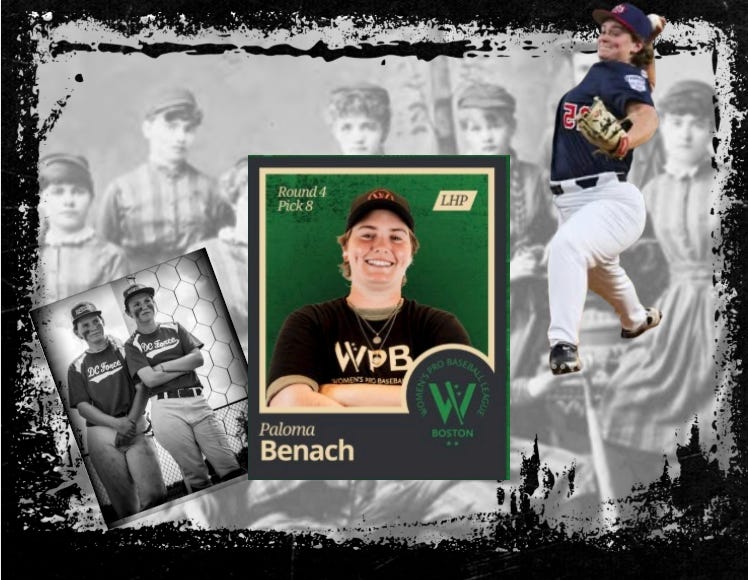
The dream was not an unusual one for an all-American child.
“Like any kid I definitely dreamed of playing in Yankee Stadium and having my name on the back of my pinstripe jersey,” said 23-year-old Paloma Benach.
And yes, she knew the limits of that dream.
Pauls, Petes and Patricks have played in the legendary stadium. But even as the lefty persisted, pitching beautiful, front-door curve balls and baffling changeups as the only girl — and the captain — on a dominant D.C. high school baseball team, then in college, heck on any damn field where she could assemble or join a group of female baseball players who refused to listen to everyone telling them to “just play softball,” there was little hope that a Paloma would stand on a mound and get paid for it.
Then, exactly 70 years after the wartime, All-American Girls Professional Baseball League (the one featured in League of Their Own, a film Paloma can recite “word for word”) was disbanded and the game was handed back to men, there was an announcement in 2024 that a new women’s league is coming. That was just as Paloma was trying to stomach the possibility that her baseball playing career was over.
It all came together last Saturday, the week that women’s professional baseball returned to the U.S.
“A dream is coming true. Paloma Benach is going to the show!” her mom, D.C. immigration lawyer Ava Benach announced on Facebook last week, when Paloma got the call to join her team in Springfield.
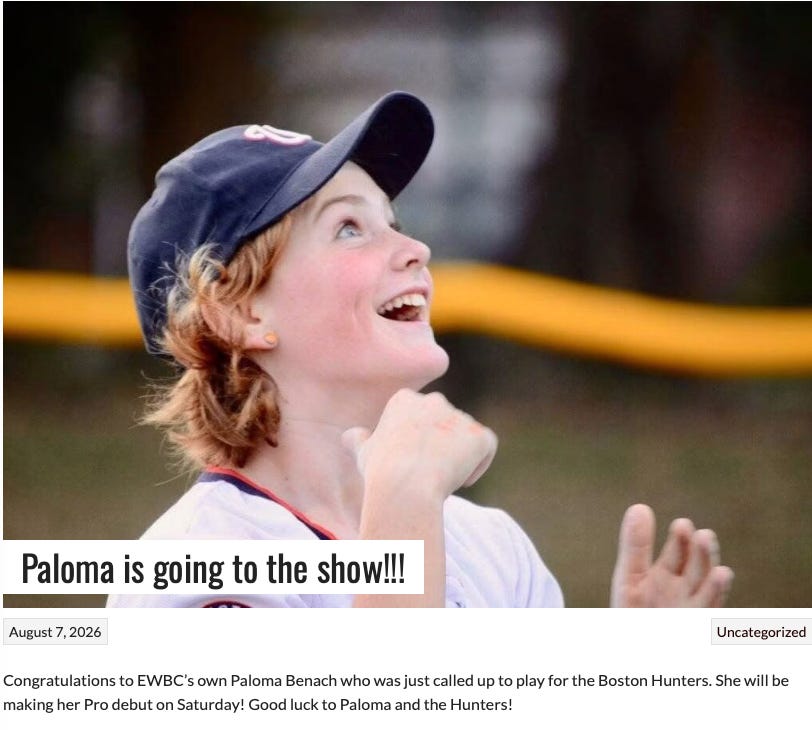
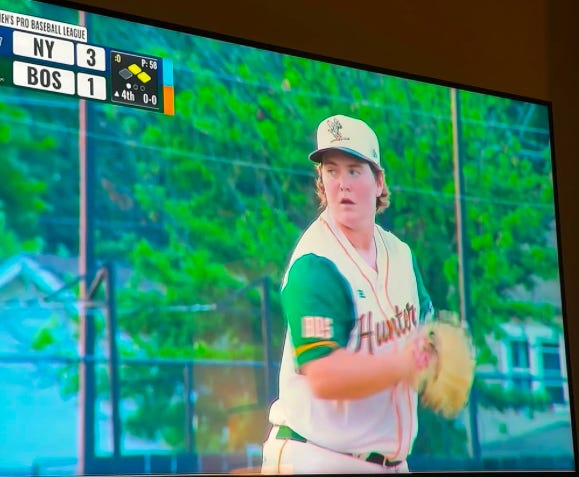
Paloma said it’s been “pure elation” since she was drafted last year by the Boston Hunters . “I had been ready to accept a somewhat natural end to my career,” she said. “This league has completely changed my outlook on what I can work for and what is possible for me.”
None of this is new.
“Decade after decade in the nineteenth century, the popular press and baseball boosters perpetuated misinformation and historical amnesia about female players by labeling each new athlete or team as a ‘novelty,’ wrote Debra A. Shattuck in her book, Bloomer Girls, which proves women have been playing professional baseball as long as men have.
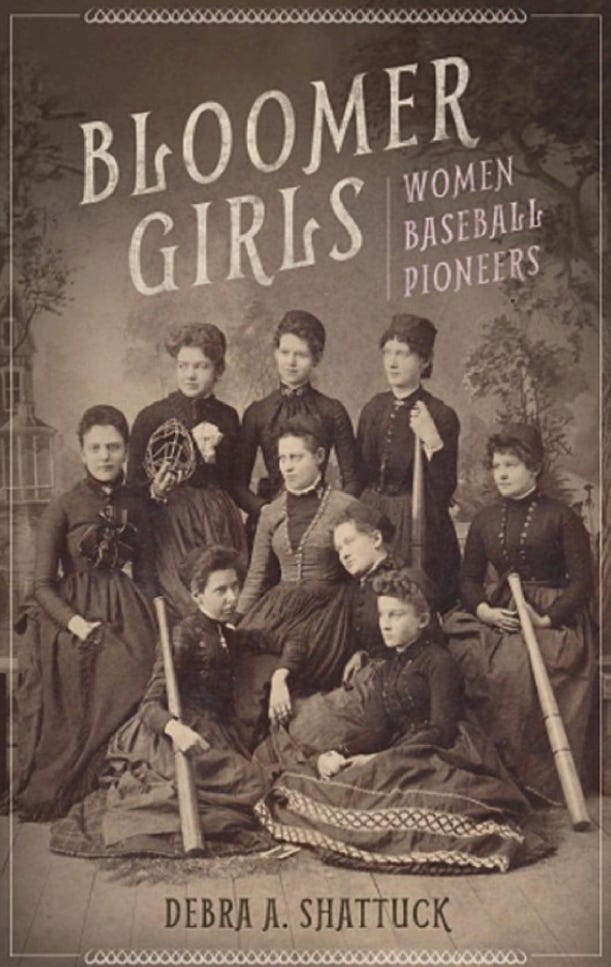
The Vassar College women’s team played in ankle-length, wool dresses in 1866, three years before the Cincinnati Red Stockings formed in 1869, according to the Baseball Hall of Fame.
The Dolly Vardens, an all-Black women’s baseball team based in Philadelphia, formed in 1867.
Springfield’s Blondes and Brunettes began playing in 1875 and became the first women’s team to get paid to play.
Barnstorming women’s teams played across the nation, often beating local men’s teams. But because they often played under “stage names” or disappeared when they married and took their husbands’ names, they “became invisible to historians,” Shattuck wrote.
The names that were recorded did so when they were part of men’s sports. In 1898, Lizzie Arlington became what is believed to be the first woman to play on a men’s professional team, pitching one inning with two hits, one walk, and no runs for the minor league Reading Coal Heavers in Pennsylvania.
Baseball fans lost their minds in 1907 when Alta Weiss began pitching for the semi-pro Vermilion Independents in Vermilion, Ohio. Thousands flocked to the games and special train cars had to be arranged to accommodate the crowds. The sports pages went on and on about her “shapely member.”
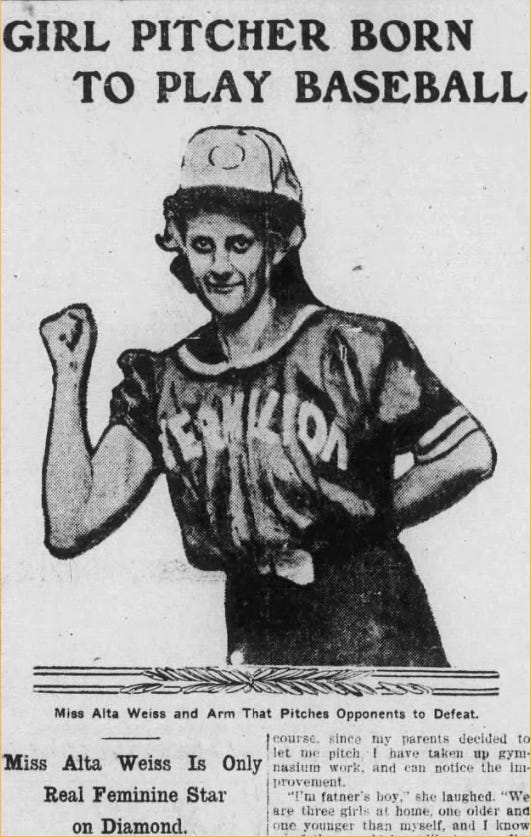
“There are no ugly bumps or Rocky Mountain ranges to spoil the symmetry of the Alta Weiss arm,” wrote The Omaha Daily News, obsessing that her “slender and round wrist swells into fuller beauty in the forearm.”
Whatevs. Alta made some cash on the game and used it to go to med school, becoming the only woman to graduate with a medical degree in 1914 from what would become The Ohio State University Medical College.
So it’s not novel or weird or new that Paloma grew up loving baseball.
“All these girls are awesome in and of themselves,” Ava Benach told me back in 2017, when I first wrote about girls in baseball. She was the coach for the 13-and-under girls team that won a national tournament, with Paloma on the mound.
“They all play on teams that are coed, they hold their own, they’re usually the only girls on their teams,” the coach said. “They’re trailblazers, because they get a lot of messages telling them to get out of baseball and go to softball.”
They didn’t listen to all that and persisted. In remarkable ways.
I’ll never forget that searing photo that ran with that column, a moody black-and-white that someone at the game took. It had Paloma and her DC Force teammate, Britt Apgar, looking defiant and glorious.
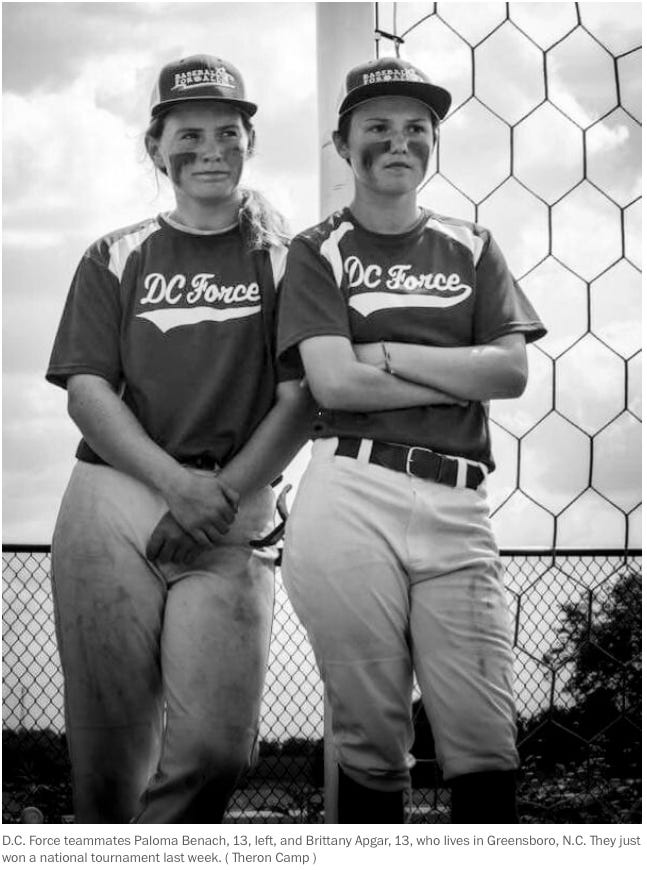
I checked up on her and Britt also made the new league, playing as a lefty pitcher for the Los Angeles Queens. And her story is another jaw-dropper. Britt was born without a right hand.
These women don’t give up.
“My mom said I am never allowed to use my hand as an excuse,” Apgar said in an AP story. “Like if I wanted to do the monkey bars, we were out there figuring out how to do the monkey bars, and they taught me how to tie my shoes before I even went to preschool. So that way I was never, like I never felt weird or different around the kids. And my dad ... if I wanted to do anything, he wanted me to put my heart into it like 100 percent.”
Wow.
Paloma also refused to be treated differently.
“I went into high school thinking, ‘this might not turn out the way I want it to be, I might have to switch to softball at some point,’” Benach told her college newspaper. “But I was lucky enough to get a really solid group of coaches and a really good group of teammates and I just kept playing.”
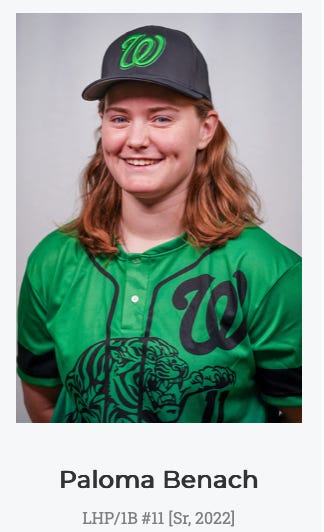
On her first day with the Jackson Reed (then Wilson) High School Tigers, the coach called them “guys and girls.” She asked him to never do that again. She didn’t want to be singled out. So “guys” it was.
And she picked a college where she could play baseball, making history as the first female to play on the Occidental College team. But it was becoming clear that it still wouldn’t be a path to the Yankee Stadium dream.
“I think at a certain point I did not necessarily give up on that dream, but rather adjusted my expectations and realigned my dreams with what felt possible at the time,” she said.
She studied psychology and thought sports psychology may have to be her pivot after graduation.
“Plan B was never away from baseball, but an adjustment of where I would be within baseball,” she said.
Then the league called, just in time. Her parents were elated, her former teams celebrated. But she’s thinking of one person every time she steps on the field – her grandfather.
“He immigrated from Cuba when he was 15 years old and put himself through school with no money,” she said. He became an influential scientist in the world of public health. And he had a stroke just a couple weeks before her professional debut.
“He worked unbelievably hard in speech therapy and physical therapy over the last couple of weeks,” she said. And he is already able to talk again.
“Even when he was sitting in the hospital having trouble speaking,” she said, “he would remember to ask about baseball.”
Great story and thank you for sharing it!
My granddaughter played on Paloma’s DCGirls Baseball team and convinced her high school, DC International to establish a coed team. She was the only girl and the captain. Unfortunately, she hasn’t been able to continue in college, but we are all so excited about Paloma’s success. Thanks for doing this story!