

Entry requirement: First, survive hell
Every Paralympic athlete is a story of remarkable Persistence

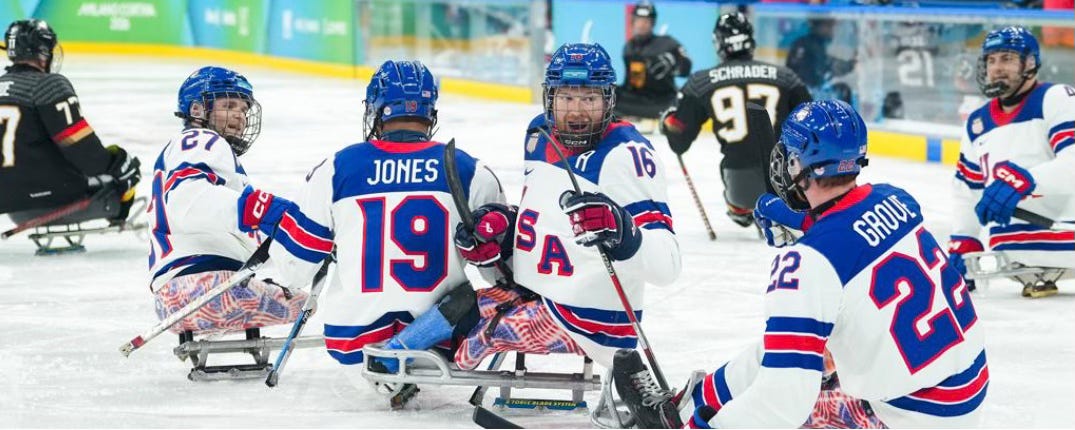
There are 611 Persisters out there this week and every one of them is breathtaking.
You know how we totally devoured the stories of the Winter Olympics, the drama, the gold, the hairstyles, the heartbreak…the controversy?
I think y’all agreed with me that the athletes who hit us right here (heart thump) are the kind who have some additional obstacles to persist through, comebacks, underdogs, compelling backstories.
If you like that kinda stuff, the Winter Paralympics this week are a feast of human triumph.
The bar for entry into these games isn’t merely excellence – the times, distances and scores the other Olympians have to put up to get an Olympic berth.
To compete in Italy this week, you had to get through some level of human hell first.
Whether they were born with physical differences into a world hostile to their bodies or their bodies changed during their lifetimes thanks to violent trauma or cruel and voracious disease, each human out there on the snow and ice had to slay a dragon before they even got to the point of strapping on skates, skis, boards or wheels.
I know it is proper for the games to celebrate their athletic achievements, but I am going to go back and lock at the obstacles they faced to get there because the stories blow my mind.
Plus, I have a deep, personal respect for what they have endured. It’s no comparison, but my husband recently faced a possible leg amputation and couldn’t walk for nearly 9 months. It shook our whole family as we saw the entire way he moved throughout the universe change radically. Eating, going from the bedroom to the bathroom, showering, going to our son’s school play, to dinner, to the doctor, to bed. Everything was different.
So yes, these athletes are next-level Persisters.
There are the folks whose lives were altered by violent trauma – car, sled, motorcycle, train, war or workplace accidents.
There is alpine skier Kelsey O’Driscoll, 32, a nurse who grew up in New Jersey skiing and surfing until she broke her spine in a sledding accident five years ago. Monday, she skied the super-G and finished 7th.
Or 48-year-old Laura Dwyer, who is making her paralympic debut in wheelchair curling after a freak accident on her job site 14 years ago left her paralyzed from the waist down. She was working as a landscaper when a 1,000-pound branch from a sugar maple randomly fell and crushed her, breaking 26 ribs, 3 toes, and her spinal cord.
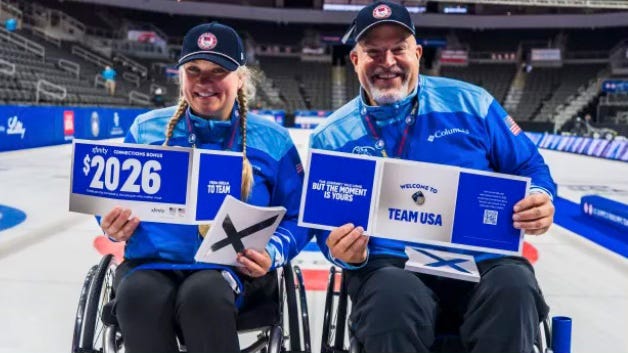
Her curling partner, Steve Emt, 56, was a walk-on basketball player at UConn who had been recruited to play at West Point when he was paralyzed from the waist down after a drunk driving incident. He was the drunk. It took him years to overcome the shame of the crash before he went back to school, got a degree and became a high school math teacher and a national speaker on the dangers of drunk driving.
Hockey player Jack Wallace, 27, was a 10-year-old waterskiing with his family when the prop on the boat sliced his right leg; it was amputated. He’s won two gold medals and this is his third paralympics as a hockey player.
Hockey goalie Jen Lee, 39, was a 22-year-old Army sergeant when he was riding his motorcycle back to the base in Florida, just days away from his second combat deployment, when he was hit by a car. He lost a leg in the accident and tried sled hockey as rehab. He now has three gold medals and is part of the paralympic hockey dream team going for another gold.

Travis Dodson, 40, was a Marine on deployment in Iraq when he lost both legs in a grenade explosion. He’s got two gold medals and is a forward on the hockey team that defeated Italy 14-1 on Saturday and shut out Germany 13-0 Monday in their quest for a fifth consecutive gold medal.
Those are the folks who found their sports as a way to reconstruct their lives.
Then there are the athletes who also had trauma, but it was quieter and attacked from inside their bodies.
Brenna Huckaby was a nationally ranked gymnast as a kid growing up in Baton Rouge, Louisiana when doctors found that her nagging hip pain was osteosarcoma, a rare bone cancer. She had her right leg amputated above the knee when she was 14 and discovered snowboarding at a rehabilitation camp. This is the third olympic games for the 30-year-old mother of two, who has won three gold medals and one bronze in her events, snowboard cross and banked slalom.

Noah Grove, now 26, was a Maryland 5-year-old when he was diagnosed with the same bone cancer in his leg. He remembers the other kids in the hospital who had the same diagnosis. His parents had to make the gut-wrenching decision to choose amputation or to try to defeat the cancer.
“All of them had the option to amputate and they didn’t,” Grove said in a recent interview, “and none of them are living today.”
And then there are the athletes who have been adapting their entire lives, whose courage from within supersedes a world that is a constant challenge to their normal.
Superstar Kendall Gretsch , 33, (four gold, three silver, two bronze) was born with spina bifida and grew up swimming, rockclimbing, playing softball and basketball. In college, she took up paratriathlon. She is among a tiny group of athletes who have gold medals in the winter and summer games. This year, she’s already bagged two medals: the bronze in the biathlon women’s 12.5 km sitting race. That’s where they pole for 7.7 miles, and stop along the way and precision shoot. (It’s really hard when you’re winded, I tried it when I was a nordic racer in high school, because I was a pretty good shot and thought I’d slay at this sport. I did not.) Gretcsh also won silver in the 7.5 km version of the race.

Flag bearer Josh Pauls, 33, is the most decorated paralympic hockey player, joining the hockey team for the Vancouver 2010 games. He has four gold medals. From age 17, he’s been there for every win in the team’s historic streak. Pauls was born without a tibia in both legs and had them both amputated when he was an infant. He started playing sled hockey when he was 8.
The story I have become obsessed with, however, is the most decorated paralympian in U.S. history – 36-year-old Oksana Masters.

She opened with authority this year, winning another gold on the first day of the games, this one in biathlon.
Her career count so far is 20, including 10 gold, 7 silver and three bronze. Six of them are from summer games, where she competes in rowing and cycling.
Impressed yet?
Every step of her life has been a middle finger to circumstance and a triumph of persistence.
She was born in Ukraine, her little body dramatically altered by the radiation still coming from the Chernobyl disaster.
Her biography goes into the horrifying existence in an orphanage – dark and cold rooms, physical and sexual abuse, mental torture. She remembered the stomach pain from constant hunger and stealing plums from a nearby tree and seeds from sunflowers to supplement the orphanage diet.
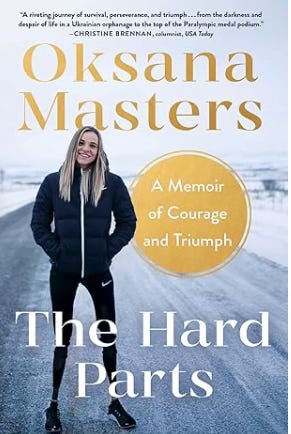
“Right from birth I was put up for adoption,” Oksana Masters said in a BBC interview.
“I was born with six toes, I was missing the main weight-bearing bones in my legs, my knees were floating - they weren’t supported by anything. My hands were webbed; I was born with five fingers, without thumbs. I don’t have a right bicep, I’m missing some organs. I have one kidney and don’t have any enamel on my teeth. When I came to America I found out that the only thing that can strip enamel before birth is radiation.”
Her life changed when an American college professor with an audacious capacity for love adopted her when she was 7 years old.
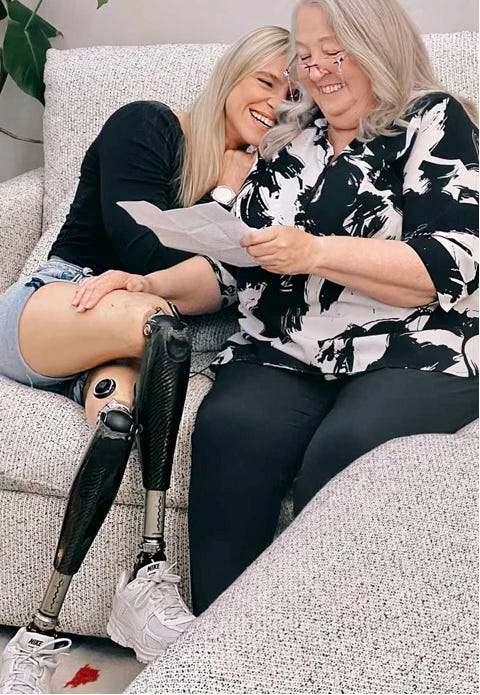
It took Melanie Gay Masters two years of paperwork and visits to make the adoption official. Two years after Oksana came to live with her, the birth defects ravaged her body and amputations began.
By 14, she had lost both legs.
But she persisted, her mother persisted. They found adaptive sports as a way for the active and agile girl to expend her energy. It began with rowing in their hometown of Louisville, Kentucky.
Masters writes with unflinching detail about her life and the reasons why she speaks out.
"I kept thinking about the other women out there, and other children, and all that they have been through — and how meaningful my story might be to them,” she wrote. “I kept thinking about how important it might be for them to see me, not just unbroken, but alive and well. Not as some object of pity, but as an example of strength. As a woman who has gained power on the other side of her trauma, and who deserves to be known, not as the sum of her experiences, but as the sum of her actions."
I’ll follow more Paralympics this week. Any sports or stories y’all want to hear more about?
You should watch the documentary “Murderball”. It’s about young men who have overcome similar obstacles to play wheelchair basketball. It’s gritty and funny and shows how they are young men dealing with a disability, not young men defined by that disability. It was nominated that year for an Oscar as best documentary but got beaten by “March of the Penguins”. Frankly, cute as penguins are, I thought the human beings beat them hollow.
Thanks for this post about the extraordinary Paralympic athletes. Paralympics should be an integral part of the Olympics and celebrated at least as much, for the reasons you note.