

They heard the Declaration and decided to kill Gold George
Today is the 250th anniversary of America's first statue takedown. They turned it into ammo to kill British troops.

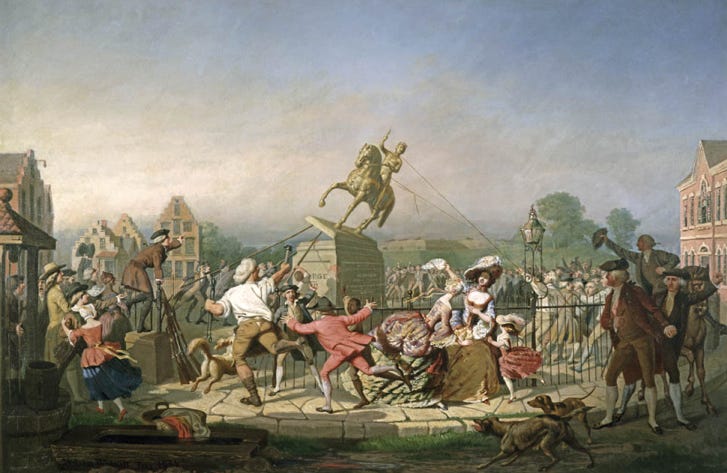
A tyrant put up a gold monument to himself and persisters who were sick of his shit and the way he used their taxes tore it down. That’s what happened right after the Declaration of Independence was written 250 years ago.
There were “loud huzzas,” the “utmost demonstrations of joy,” and then a mob toppled a massive statue of King George on his horse.
This was July 9, 1776, five days after the Declaration of Independence was written and news of it reached the troops in New York.
“The same evening the equestrian statue of George III, which Tory pride and folly raised in the year 1770, was, by the sons of freedom, laid prostrate in the dirt, the just des[s]ert of an ungrateful tyrant!”, according to breaking news in a local paper, The Virginia Gazette, on July 26, 1776.
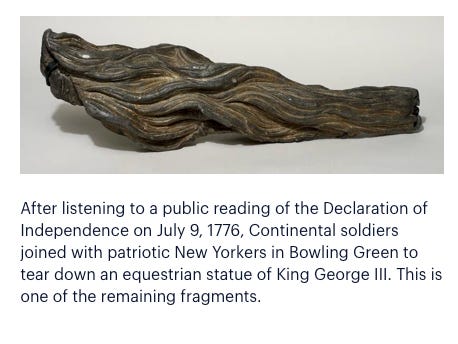
The continental army shipped the pieces to Connecticut, where “patriotic women and children” on the Wolcott farm melted the damned thing into 42,088 musket balls, according to the kind of historical research that is now being attacked by this administration for the full telling of America’s story.
High-tech science techniques showed that some of King George’s “melted majesty” balls were fired at the Battle of Monmouth, according to the Museum of the American Revolution and the work of battlefield historian Daniel Sivilich. The rest of the statue’s remains amount to a horse’s tail, on display at New York Historical Society.
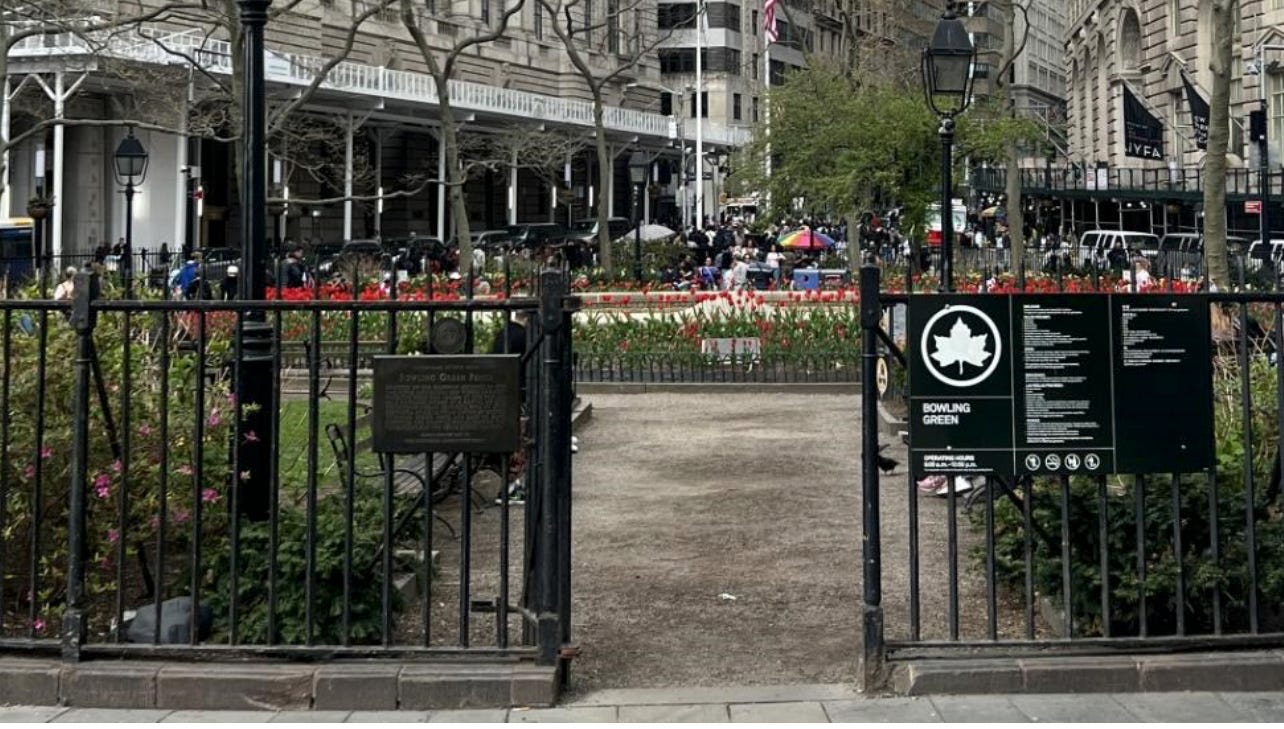
This all happened in Manhattan’s oldest park, Bowling Green, which is right by a statue that America seems to love a whole lot more: the Charging Bull of Wall Street.
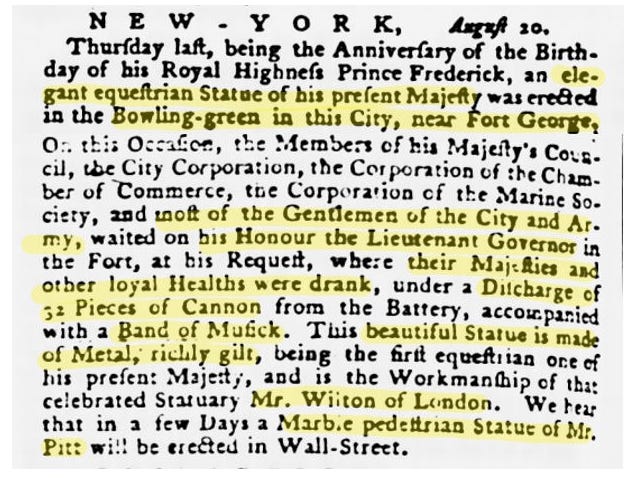
The first garish, looming monument in that space came about because King George needed an ego boost in the colonies, where folks were figuring out how much he’d been screwing them over. The massive statue — lead covered in gold, on a horse and dressed like Roman Emperor Marcus Aurelius — was dedicated on one of the prince’s birthdays. KG’s lackeys in New York attended the ceremony, where they drank, heard the fire of “32 pieces of Cannon from the Battery, accompanied with a Band of Musick,” the Maryland Gazette reported on Aug. 20, 1770.
King George had to keep showing the colonists how great he was. And as the revolution began to simmer, gold George in New York kept getting trashed by patriotic vandals. The next year, officials put a fancy fence that cost almost as much as the statue, 800 pounds sterling (about $225,000 today), to stop the damage. That fence is still there today. But it didn’t do much to stop the patriotic persisters from throwing tar on the gold king. So in 1773, they passed an “Act of prevent the defacing [of] statues”.
Six years later, New Yorkers headed straight for that hated statue the moment they heard the guttural screed that was the Declaration of Independence read aloud. It was all the things they’d been saying about King George in their taverns and at their tables. (Too mild, even, some of them said.)
Sure, the Declaration we all celebrated last weekend has some catchy lines that make cool posters and tattoos:
“We hold these truths to be self-evident”
“All men are created equal”
“Life, Liberty and the Pursuit of Happiness.”
But most of that document is a scathing takedown outlining how fed up the colonists were with the narcissistic and cruel King:
He was “A prince whose character is thus marked by every act which may define a Tyrant, is unfit to be the ruler of a free people.”
“He has dissolved the Representative Houses repeatedly, for opposing with manly firmness his invasion on the rights of people.”
“He has refused his Assent to Laws, the most wholesome and necessary for the public good.”
“He has erected a multitude of New Offices, and sent hither swarms of Officers to harrass our people, and eat out their substance.”
“He has kept among us, in times of peace, Standing Armies without the Consent of our legislatures.”
“He has affected to render the Military independent of and superior to the Civil power.”
His pals suspended “our own Legislatures, and declaring themselves invested with power to legislate for us in all cases whatsoever.”
“The history of the present King of Great Britain is a history of repeated injuries and usurpations, all having in direct object the establishment of an absolute Tyranny over these States”
“He has endeavoured to prevent the population of these States; for that purpose obstructing the Laws of Naturalization of Foreigners; refusing to pass others to encourage their migration hither…”
In other words — No Kings.